Just in case you didn’t know, WaniKani is a web-based platform for learning kanji and vocabulary with it’s own SRS (spaced repetition system). It’s what I use to learn kanji and I will admit that I have a long and complicated history with it. After going between WaniKani, Anki and other kanji based books (Kodansha Kanji Learner’s Course, Kanji in Context – which I still use sometimes) I would say WaniKani has been the most useful to me.
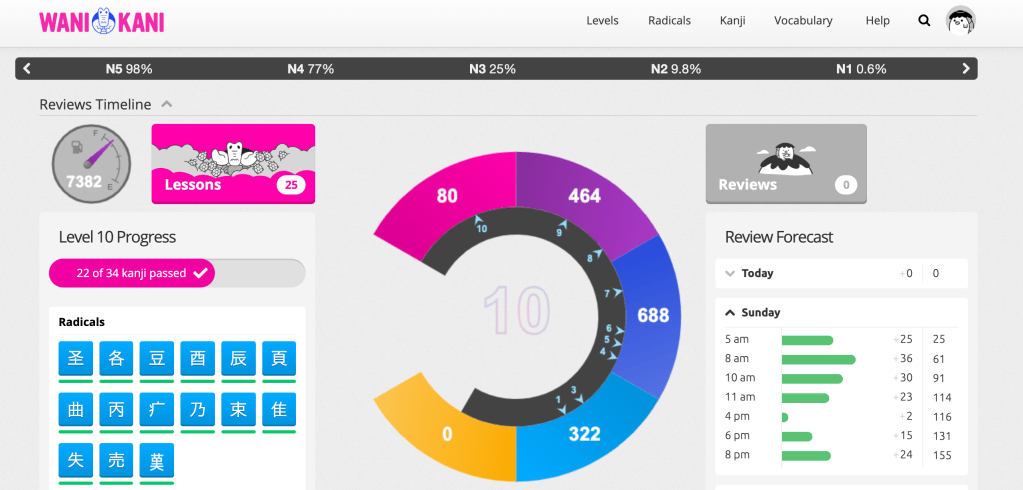
I first started in 2012 and went in head first. When I levelled up I liked to clear all of my lessons at once, which meant that they appeared in the review queue at the same time (think 100 at a time, enough to put anyone off). I made it to level 25 before I burned out, turned on vacation mode and went away for a while. A couple of years later (2016 I think?) I logged in again, struggled to work through my around 1,000 review pile and ended up resetting back to level 20… only problem is I’d forgotten a lot of what I’d learned and this made the reviews I had left extra challenging and demotivating. I bought a lifetime membership on sale around this time and was determined to give it another go, so I reset a bit further back but honestly, I really needed to start again. I started studying kanji on my own and left WaniKani for a couple of years, until this year…
Before restarting WaniKani I browsed the community forum, which is what I should have done from the start. Many people restart for various reasons so I decided to read their stories, and of those who had made it to level 60 for tips. In May 2021 I decided to reset my level back to 1 and start from the very beginning, and this is what I have learned.
- Space out your lessons for an easier experience! Instead of doing them all in one go and experiencing review burnout, do them in batches. When I start a level I always start with the radicals. I wait a day and then do the kanji (unless the amount is reasonable and I can do them with the radicals), and then spread out the vocab until the second part of the level. When the second load of kanji and vocab come around I then start with the kanji, and again spread the vocab out until the end of the level. I average a level in just under 8 days right now and I can (most of the time) have lessons each day (I aim for 20-30 a day depending on how many I’m left with).
- Userscripts aren’t cheating, they’re your friend! Some people on the community forum are against using userscripts and accuse those who get to level 60 quickly as cheating, but if you’re using the userscripts for cheating then you’re only cheating yourself. Use the userscripts how you want to, as it is your learning journey and if it works for you then fine. My favourite is the re-ordering script, which means I can focus on either radicals, kanji or vocab in my lesson sessions, and also choose how many if there’s a specific number I want to complete in that sitting. You can also use userscripts to change your dashboard and show you things like what percentage of JLPT kanji by level you’ve covered, or a heatmap (my favourite dashboard userscript) to show you reviews/lessons by day, if you have a streak going on and a review forecast to see how many you have. I can see that I will start burning items in November, so I’d better get ready!
- WaniKani shouldn’t be your only source of vocabulary and language study; you should supplement it with other materials. WaniKani is kanji and vocabulary only, and to get a well rounded learning experience you should consider bringing in a grammar resource (a beginner textbook if Japanese is completely new to you, I personally use Bunpro and the Japanese Grammar dictionaries for my own studies), immersion materials for additional vocabularly and listening practice, and a language partner/conversation classes if you want to work on speaking. WaniKani is only one part of my language puzzle and I love that it’s something I can do each day, supplementing the vocabulary I learn elsewhere.
- Rely on your memory rather than writing everything down. When I first started I had a notebook that I would write everything down in, same for when I restarted several times. If I struggled I would look at my notes and didn’t work on drilling it into my memory. Now, I only write down kanji into my kanji practice book to practice writing – I write them when I first encounter them in my lessons, look up the stroke order in my dictionary app and practice writing them. If I’m struggling with particular vocabulary I might write that down on a bit of scrap paper until I’m better at recognising it or stick it in an Anki deck as part of a sentence, but I don’t have a WaniKani notebook anymore as that was too much of a crutch.
I’m level 11 at the time of writing this and I can’t wait to see how I’m feeling when I get back to level 25. I hope it will be less torturous because I’ve spaced myself out more and I have a better way of coping with large amounts of lessons and reviews. I’m more comfortable with seeing numbers rather than having a 0 lessons and 0 reviews counter at the end of the day, which helps a lot! My goal is level 60 of course (why else would I have bought a lifetime membership?!), and I would like to get there without taking an extended break.
Do you use WaniKani to study kanji? Or do you use Anki, or another method?
 アマンダの勉強 / Amanda Learns!